
From its lows in December, the stock of Tata Motors is up about 15 per cent. The gains came on the back of better than expected December volumes in its UK-based subsidiary Jaguar Land Rover (JLR). This coupled with gradual recovery in the global passenger vehicle demand, improving profitability due to product mix and lower commodity costs are expected to be key positives for the company.

The stock of Godrej Consumer Products Limited (GCPL) fell about 3.7 per cent in trade after its Q3FY24 earnings disappointed brokerages and led to downgrades. Further, the stock, after a 15 per cent run-up over the past month prior to Monday's correction, had already factored in the upside from the business front. Its peer in the consumer space, Marico, too, saw a 4 per cent drop in its stock price.

Tata Group remained India's largest business conglomerate in market capitalisation in calendar year 2023 while the Mukesh Ambani camp raced ahead of the Adani businesses to become the second-largest. The Tata companies ended 2023 with a combined group market capitalisation of Rs 28.68 trillion, up 35 per cent from the Rs 21.2 trillion at the end of December 2022. Ambani's group mcap is Rs 19.42 trillion at the end of CY23, up 10.7 per cent from the Rs 17.6 trillion a year ago.

As much as Rs 47,810 crore was spent on share buybacks by 48 companies in 2023 -- the highest amount since 2017. This surge in value was largely driven by a few large-sized issues, including those by Tata Consultancy Services (Rs 17,000 crore), Larsen & Toubro (Rs 10,000 crore), and Wipro (Rs 12,000 crore). In 2022, 58 companies had repurchased shares worth Rs 38,305 crore, according to data from Prime Database.

The combined market capitalisation of Adani group companies increased to Rs 15.11 trillion last week. As a result, Gautam Adani's family raced ahead of Mukesh Ambani of Reliance Industries, reclaiming the title of India's wealthiest promoter.

The IPO boom in 2023 added four new promoters to the billionaires' list.

Despite multiple headwinds at the start of 2023, the Indian markets delivered a strong performance, posting 19-20 per cent growth for the year. Even as new records were set, investor sentiment remains strong going into 2024, given the lower inflation, expectations of steady to lower interest rates, higher economic growth, and strong inflows. However, the overriding concern for most brokerages is valuations.

Dabur India has been the worst performer in the fast-moving consumer goods (FMCG) space this year (CY23), posting a 1 per cent decline even as its peer index, the Nifty FMCG, has delivered returns of over 29 per cent in this period.

Bharat Forge, the Pune-based automotive component maker, has been one of the top-performing companies in its segment. The company's stock price is up 39.3 per cent since the beginning of the 2023 calendar year, surpassing other leading automotive component makers such as Bosch and Samvardhana Motherson International. The stock also outperformed the benchmark BSE Sensex, which is up 17.3 per cent year to date so far.
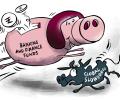
Even as banks and finance companies are reporting record-high earnings, their weighting in the benchmark National Stock Exchange Nifty50 Index has seen a downward trajectory. Investors expect a stronger performance from other sectors in the new year. Currently, banking, financial services and insurance (BFSI) companies collectively hold a weighting of 34.5 per cent, down from 36.7 per cent at the end of December 2022 and a record high of 40.6 per cent at the end of December 2019. This represents the sector's lowest weighting in the index since December 2021 when it stood at 33.7 per cent.

The Indian equity market valuation has been moving in tandem with the US 10-year treasury yield. While the benchmark US bond yield has witnessed a nearly 70 basis point decline since the end of October this year, dropping from 4.93 per cent to 4.23 per cent on Friday, the Sensex earnings yield has slipped by nearly 45 basis points - from 4.5 per cent to 4.05 per cent. Previously, Indian equities' earnings yields rose in sync with the US bond yields.

There is no near-term respite for the country's largest fast-moving consumer goods maker, Hindustan Unilever (HUL), which is facing multiple challenges on the growth front. With demand showing no signs of improvement, especially in the rural segment, the October-December quarter (Q3) of 2023-24 (FY24) is likely to be similar to the previous quarter, with volume growth in the low single digits. The stock, which is down 7 per cent over the past year compared to the 11 per cent jump for the S&P BSE Sensex, could underperform the benchmark in the near term as well.

The past 18 months have seen a resurgence in the real estate industry, with developers regaining the ground lost to the Covid-19 pandemic. But it is once again adding inventory at a pace faster than sales. The industry's inventory rose by 28 per cent year-on-year (Y-o-Y) in H1FY24, com-pared to a 25.5 per cent year-on-year increase in net sales during the same period.

The stock of fast-moving consumer goods major Tata Consumer Products has been reaching new all-time highs on better-than-expected results for the July-September quarter (second quarter, or Q2), strong growth in the food business, and margin gains in the beverage/international business. Most brokerages are positive on the stock, given growth prospects, and believe that rich valuations are justified. The near-term trigger has been the robust operational performance in Q2.

The headline for corporate profit growth has been very encouraging in the July-September quarter (Q2) of 2023-24 (FY24), with the combined net profit of listed companies up by 38 per cent year-on-year. However, the earnings distribution has been very lopsided, with most of the growth coming from public-sector oil-marketing companies (OMCs), banks, non-bank lenders, automobile (auto) companies, and cement producers. By comparison, companies from information technology services, fast-moving consumer goods (FMCG), retail, and consumer durables were disappointed, experiencing a sharp slowdown in net sales growth and a relatively muted increase in reported net profit.

With sentiment for the automotive (auto) sector turning positive, stocks of two-wheeler auto majors have been hitting their 52-week highs. Hero MotoCorp, Bajaj Auto, TVS Motor Company, and Eicher Motors recently reached their yearly highs on strong sales in the festival season and the expectation of faster growth rates ahead. Since the start of this month, listed two-wheeler majors have delivered returns in the 12-17 per cent range, compared to the 7 per cent gains for the S&P BSE Auto Index and 3 per cent for the benchmark S&P BSE Sensex.

The slowdown in corporate revenue growth over the last one year has begun to reflect in India Inc's capital expenditure, or capex. The country's top listed companies are going slow on fresh investment in capacity expansion, in line with a deceleration in their top line growth. The combined fixed assets of the listed companies, excluding banking, finance services and insurance (BFSI) and the government-owned oil & gas firms, were up 10.1 per cent year-on-year (Y-o-Y) during April-September 2023 (H1FY24) - the slowest in 18 months - as against 21.1 per cent Y-o-Y growth in H2FY23 (October 2022-March 2023) and 11.6 per cent growth in the April-September 2022 period (H1FY23).

The Mumbai-based real estate developer Oberoi Realty has been one of the top-performing companies in its segment and most brokerage remains bullish on the stock. The company's stock price is 52 per cent in the last 12 months beating the broader market by a huge margin. The benchmark BSE Sensex is up just 6.5 per cent during the period.

The K-shaped economic recovery in India from the pandemic slowdown shows in corporate results as well. The automobile sector, which represents big-ticket consumption, continues to do well and has increased its share in corporate revenues and profits while fast-moving consumer goods (FMCG) companies that sell low-ticket consumer goods are struggling with poor sales and earnings growth. The share of the automobile sector, including makers of auto ancillaries, in corporate net sales rose to a 10-quarter high of 10.05 per cent during July-September 2023 (Q2FY24) from 8.94 per cent a year earlier and 9.75 per cent in Q1FY24.

UPL, the country's largest agrochemical company, had a weak July-September quarter (Q2), reporting a sharp fall in revenues across geographies. Overall, the revenues were down 19 per cent on the back of lower agrochemical prices and inventory destocking. While the overall volumes were down 7 per cent, prices fell by 15 per cent. Volume decline in the European market was on the back of high channel inventory and product bans while in India the fall by 27 per cent was on account of muted demand for segments such as cotton and pulses.
